Monthly Archives: August 2026

Light as ‘pure information’

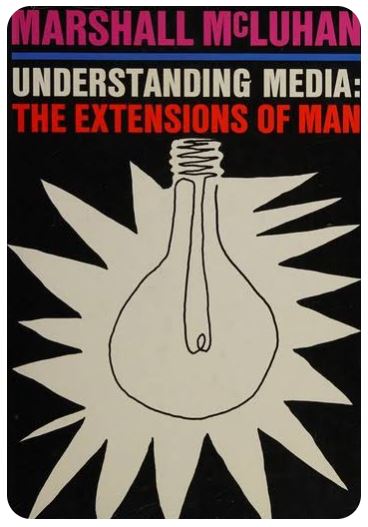
As documented in the passages below from Understanding Media (hereafter UM), McLuhan often maintained that light was unique in being “a medium without a message” (UM 9). Since light can illuminate anything at all (“without any [particular] content to restrict its transforming and informing power”), it had no distinguishing message. It was thus “pure information” (UM 9), “pure information without any content” (UM 62).
“Except for light, all other media come in pairs” (UM 62). Since all other media do have a correlated message, and since a message requires a medium, no medium aside from light could fail to be paired with another medium:1 

This fact, characteristic of all media [namely, that they always have content or a message], means that the “content” of any medium is always another medium [since there is no content or message without a medium].2 The content of writing is speech, just as the written word is the content of print, and print is the content of the telegraph. If it is asked, “What is the content of speech?,” it is necessary to say, “It is an actual process of thought, which is in itself nonverbal”.3 (UM 9)

But doesn’t light always have the implicated content of a certain degree of darkness? And if so, by maintaining such a “pure” view of light, by arguing that “electric light abolished the divisions of night and day” (UM 141), doesn’t McLuhan violate his own strictures against 

a Plotinian world-culture which implements the non-human and superhuman doctrines of neo-Platonic angelism to the point where the human dimension is obliterated.4 

It may be, indeed, that the great burst of energy represented by the writing of UM in 1962-1963 (especially ‘in light’ of McLuhan’s health at the time)5 posed — and perhaps posed first of all to his own work? — just this question of the ineluctable implication of the dark:

Examination of the origin and development of the individual extensions of man [that is, part 2 of UM] should be preceded [in part 1] by a look at some general aspects of the media (…) beginning with the never-explained numbness that each extension brings about in the individual and society. (UM 6)

This thought will be taken up in a further post ‘On the origin and necessity of numb’.

Meanwhile here are passages from UM in which McLuhan puts forward the notion that light is a unique medium of “pure information”:

The instance of the electric light may prove illuminating (…) electric light is pure information. [Unlike all other media] it is a medium without a message (…) When [electric] light is being used for brain surgery or night baseball is a matter of indifference. It could be argued that these activities are in some way the “content” of the electric light, since they could not exist without the electric light. This fact merely underlines the point that “the medium is the message” because it is the medium that shapes and controls the scale and form of human association and action.6 UM 9-10

electric light ended the regime of night and day, of indoors and out-of-doors. But it is when the light encounters already existing patterns of human organization that the hybrid energy is released. Cars can travel all night, ball players can play all night, and windows [for light] can be left out of buildings. In a word, the message of the electric light is total change. It is pure information without any content to restrict its transforming and informing power. If the student of media will but meditate on the power of this medium of electric light to transform every structure of time and space and work and society that it penetrates or contacts, he will have the key to the form of the power that is in all media to reshape any lives that they touch. Except for light, all other media come in pairs, with one acting as the “content” of the other, obscuring the operation of both. (UM 62) 

In the twentieth century we are familiar with the changes in housing and architecture that are the result of electric energy made available to elevators. The same energy devoted to lighting has altered our living and working spaces even more radically. Electric light abolished the divisions of night and day, of inner and outer, and of the subterranean and the terrestrial. It altered every consideration of space for work and production as much as the other electric media had altered the space-time experience of society. (UM 141)


  1. In early 1964, shortly after he had finished writing UM, McLuhan came across Wolfgang Köhler’s Gestalt Psychology in which the universal application of figure and ground is argued and illustrated. The f/g structure became a central feature of McLuhan’s work from then on. For background, see James Tenney and Wolfgang Köhler.
  2. As seen here, McLuhan’s thought and writing jump around, withholding connections. Like abstract painting in his telling, they thereby manifest “creative thought processes”. See the following note.
  3. McLuhan continues here: “An abstract painting represents direct manifestation of creative thought processes”. His interesting point is that the shapes, colors, layers and brushstrokes of an abstract painting are effects which illuminate what manifests them, namely, “creative thought processes”. They are like a diamond and graphite produced by a chemist to specify carbon by showing how variously it can manifest itself.
  4. Nihilism Exposed, 1955. In his anxiety to communicate his work, McLuhan often attenuated the difference between figure and ground as regards such central matters as ‘media’, the ‘senses’ and, as here, ‘light’. He wanted to provide ‘something to grab hold of’. While this did indeed elicit the interest he wanted to provoke, especially in regard to ‘media’, it did so at the expense of essential confusion. As McLuhan wrote to his old friend, Morton Bloomfield (the two taught at the University of Wisconsin together almost 40 years before in 1936-1937): “I have begun to realize that my peculiar approach to all matters has been to enter via the ground rather than the figure.” (March 26,1973, Letters 473) Indeed, in any science the imperative is exactly “to enter via the ground rather than the figure”: elements in chemistry, genes in genetics, etc. Now this is arguably the central point of Plato’s Republic, turning on the essential difference between the intelligible and the sensible. But the fact that this essential difference, and especially the priority of intelligible ground to sensible figure, have not been understood in the artefactual domain over 2400 years shows the difficulty, or perhaps the fearsomeness, of the required insight and conceptual leap. That McLuhan himself had “begun to realize” this in regard to his own work only in 1973 is telling. In any case, it is a point which remains entirely missing in McLuhan research (to mention only McLuhan research), much to the detriment of the surrounding world which so desperately needs open collective investigation — that is to say science — into the artefactual realm of the thought, experience and actions of human beings, both individual and social.
  5. See McLuhan’s health 1957-1967.
  6. UM 10: “What we are considering here (…) are the psychic and social consequences of the designs or patterns as they amplify or accelerate existing processes. For the “message” of any medium or technology is the change of scale or pace or pattern that it introduces into human affairs. The railway did not introduce movement or transportation or wheel or road into human society, but it accelerated and enlarged the scale of (such) previous human functions, creating totally new kinds of cities and new kinds of work and leisure. This happened whether the railway functioned in a tropical or a northern environment and is quite independent of the freight or content of the railway medium. The airplane (…) by accelerating the rate of transportation, tends to dissolve the railway form of city, politics, and association, quite independently of what the airplane is used for. (…) The content or uses of such media are as diverse as they are ineffectual in shaping the form of human association. Indeed, it is only too typical that the ‘content’ of any medium blinds us to the character of the medium.”

Clues from compounds

The hybridizing or compounding of these [media] agents offers an especially favorable opportunity to notice their structural components and properties. (Understanding Media, 49) 

The hybrid or the meeting of two media is a moment of truth and revelation from which new form is born. (Understanding Media, 66)

When the foundations of chemistry were first being laid around 1800, compounds like mercuric oxide, water and salt were critical in the effort to isolate the physical elements, determine their properties and discover the laws of their combination. McLuhan thought something very similar could be pursued in establishing the new sciences of media.

In fact, of all the great hybrid unions that breed furious release of energy and change, there is none to surpass the meeting of literate and oral cultures. The giving to man of an eye for an ear by phonetic literacy is, socially and politically, probably the most radical explosion that can occur in any social structure. (Understanding Media, 49) 

The ultimate conflict between sight and sound, between written and oral kinds of perception and organization of existence is upon us.(Understanding Media, 16)

Just such a “hybrid union” of eye and ear occurred in McLuhan’s research in the 1950s with an attendant “furious release of energy and change”. Now our research today must revert to his to start again in the effort he initiated to isolate the artefactual elements and their laws in the new sciences of media.

Jonas on ‘Jimmy’

Being constantly submerged in a sea of stimuli impinging on our minds we tend to reduce the impact selectively by a shutting-out mechanism. (Irritation and Counterirritation, 193)

McLuhan must have recognized much of his own health condition in the case of ‘Jimmy’ as described by A.D. Jonas in his 1962 Irritation and Counterirritation. Perhaps McLuhan even self-diagnosed his 1960 stroke and repeated blackouts before and after that stroke on the basis of Jonas’ “mechanism”? In this view, these were “autoamputations” of his CNS (central nervous system) acting as “counterirritations” induced by his “living in a sea of subliminal and supraliminal insults” (Irritation and Counterirritation, 12).

Depictions of McLuhan’s state at this time by himself and others have been given in McLuhan’s health 1957-1967. Compare the case of ‘Jimmy’ set out by Jonas:

[Jimmy’s] growing annoyance and irritation became a source of preoccupation to his wife. Her remonstrations to take time off for his family or have some free time for himself were countered with (…) silence. This was the (…) background against which Jimmy developed severe headaches forcing him to consume from five to ten aspirins daily. Repeated medical check-ups failed to provide any clues (…) Alternately he would fear losing his mind or dying from a brain tumor. Applying the hypothesis that the brain will not tolerate excessive stimulation and therefore, in such an instance, will set into motion an amputative process, a certain sequence of events can be predicted. The sensory organs will become reduced in their effectiveness in such a way that fewer and less intense stimuli will filter through. As a further protection the muscles surrounding the skull will tighten to lessen the impact of external blows (…) The intense muscular contractions combined with vascular changes — the characteristics of the clinical picture of a headache — are the visible manifestation of the autoamputative process of the brain [working] to eliminate itself, a form of biological suicide (…) Jimmy would state that (…) he would experience relief if he just could split his head open (…) effectively desensitizing himself to all the outside and internal stimuli. (Irritation and Counterirritation, 97-98)

Here is McLuhan in Understanding Media (43):

With the arrival of electric technology, man extended, or set outside himself, a live model of the central nervous system itself. To the degree that this is so, it is a development that suggests [the need for] a desperate and suicidal autoamputation, as if the central nervous system could no longer depend on the physical organs [alone] to be protective buffers against the slings and arrows of outrageous mechanism.1

And here is Jonas in Irritation and Counterirritation (12):

the CNS has successively surrounded itself with more and more complex organ systems to maintain for itself an optimum state (…) The ultimate crowning of such a development is the advanced intellectual capacity seen in men. But from the standpoint of optimum functional environment for the CNS, man must be considered a failure, because the very degree of advancement has made it excessively vulnerable to constant irritation. 

  1. McLuhan continues here: “It could well be that the successive mechanizations of the various physical organs since the invention of printing have made too violent and superstimulated a social experience for the central nervous system to endure.”

McLuhan’s health 1957-1967

In the fall of 1967, McLuhan was diagnosed with a large brain tumour which was removed in a day-long operation. Throughout the preceding decade he had suffered from blackouts and severe headaches. And in 1960 he had experienced a life-threatening stroke.

In Letters (175), the start of McLuhan’s blackouts is dated to 1959. But when the family drove out to California to spend the summer of 1958 in Santa Barbara, Corinne did the driving. This must mean that Marshall was already experiencing blackouts at that time. It is entirely conceivable, indeed, that Corinne had already had the frightening experience of one of Marshall’s blackouts when he was driving. However that may have been, Marshall’s blackouts must have started by 1958, if not a year or two earlier, and whenever that was, Corinne would not have let him drive thereafter. Then in 1960 he suffered a stroke from which it was feared he would die. From that near fatal event until his brain tumour was removed seven years later, he was continually agitated.  The passages below describe his health during this decade between 1957 and 1967.

Judith Fitzgerald, Marshall McLuhan: Wise Guy, 2001, 97

In a note attached to the [NAEB] Report (on Understanding New Media, 1960), McLuhan reveals his health has broken under the stress of prolonged overwork on the project. He’s recently been released from hospital and his doctor insists he take a good long rest, advice a hospital-phobe such as McLuhan (…) is inclined to follow. Ted Carpenter, McLuhan s long-time U of T friend and fellow Ford-Foundation researcher, confirms McLuhan did indeed suffer a stroke earlier that year, a stroke that caused such alarm his employer (and confessor) Father John Kelly was summoned to administer the Last Rites. When McLuhan returns to teaching (…), however, he cavalierly pretends he never suffered a stroke. But his family and close friends can clearly see the toll it’s taken: the man who was a robust and animated specimen has turned into an old man overnight. His nervous intensity’s more pronounced. He’s incapable of relaxing for more than five minutes at a stretch. 

Douglas Coupland, Marshall McLuhan : you know nothing of my work!, 2010, 132

Producing the [NAEB] book came with a price. The two years spent making it were arguably the most exploration-rich of Marshall’s life. But the stress on his brain took a toll. In early 1960 he suffered a stroke so severe that a priest was called in for last rites. Marshall survived but was forced to rest by his doctor. The medical event was kept under wraps, and in the fall of 1961, Marshall resumed teaching, with only a few people close to him aware of the intellectual and physical journey he’d been on.

Ted Carpenter, ‘On McLuhan and Explorations‘, 20111

 the [1960 NAEB] book was a disaster, Marshall was very sick to the point where they administered the last rights (…) Marshall had a seizure (…) and it changed his personality (…) Marshall was a changed person after that stroke or seizure or whatever it was. He was a different person. There would be times when the old Spirit would come back (…) but there were other times of chaos and it was quite sad (…) believe me I saw things that I would prefer not to have seen (…) I moved [from California] to join Marshall at Fordham University [in 1967] and that did not work out, he was not well, he was quite ill… 

Ted Carpenter, ‘That Not-So-Silent Sea’, 20012

Marshall asked me to join him at Fordham. Thanks to [Howard] Gossage’s obedient journalists, he was now internationally famous, the world’s first celebrity scholar. He was also very ill. A brain tumor was removed. Warmth and brilliance faded.3 I recall a moment backstage before he faced an audience of executives. He called for “the book”. “The book” was A Thousand and One Jokes for All Occasions. Several were chosen at random and read to him. He laughed at each, though all were awful. In the end that didn’t matter: he mixed up punch lines, leaving his audience thoroughly perplexed. One listener asked for help in unraveling what he assumed was a deliberate riddle. Others dismissed the speaker as fraudulent or mad. Yet even in the worst scenes, there could be wit. (…) The Fordham effort collapsed. Marshall returned to Toronto. (…) The exuberant, witty rainmaker was now a wary, irritable jukebox reciting old phrases in random order. (…) It was so different when we first met, at his home in a great old house, once St. Mike’s infirmary. He stood before the fireplace, Corinne beside him, the fire bright, the two of them tall, extremely handsome, she regal, he witty, punning, quoting jazz lyrics, classics, Yeats, headlines, slang, ads, a Joycean display, then singing, not McCormack, but full of fun.

In the following passages from McLuhan himself, it may be taken that his descriptions of the effects of electric technology are less sociology than autobiographical reports of his own state at the time. The numbing and ‘autoamputation’ that he took from A.D. Jonas, Irritation and Counterirritation,4 befell him concretely with his stroke and repeated blackouts. Meanwhile the general anxiety and dread before “the condition of man” would have been his position of uncertainty as to when the next blackout or stroke might occur and how long he had to live at all.5

McLuhan, ‘Prospect’, 1962

we have projected our brains and nerves outside [ourselves]. Telegraph, radio, television, telephone really are extensions of our central nervous system (…) We’re putting (…) our most intimate selves (…) the brains and nerves of man around the globe. (…) Now, when we put our nerves outside, we become of course vulnerable to the nth degree; in fact, we barely survive from day to day. Mere existence becomes one of perpetual anxiety. (…) We now have an unimaginably harassed [life] by putting our nerves outside ourselves; it is like living without a skin (…) when you put the nervous system outside, fear is no longer the problem, anxiety is the problem. Fear is specific, anxiety is total (…) you don’t know now precisely what you’re dreading, rather it’s a pervasive state. The [very] condition of man is what you dread (…) a very heightened kind of existence, a sort of nightmare.

McLuhan, Understanding Media, 19646

The principle of numbness comes into play with electric technology (…) We have to numb our central nervous system when it is extended and exposed, or we will die.

McLuhan, Understanding Media, 19647

There is a close parallel of response between the patterns of physical and psychic trauma or shock. A person suddenly deprived of loved ones8 and a person who drops a few feet unexpectedly will both register shock. Both the loss of family and a physical fall [effect]9 amputations of the self. Shock induces a generalized numbness or an increased threshold [limiting or preventing]10 all types of perception. (…) The person who falls suddenly experiences immunity to all pain or sensory stimuli because the central nervous system has to be protected from any intense thrust of sensation. Only gradually does he regain normal sensitivity to sights and sounds, at which time he may begin to tremble and perspire and to react as he would have done if the central nervous system had been prepared in advance for the fall that occurred unexpectedly.11

McLuhan, Understanding Media, 196412

Physiologically there are abundant reasons for an extension of ourselves involving us in a state of numbness. Medical researchers like Hans Selye and Adolphe Jonas hold that all extensions of ourselves, in sickness or in health, are attempts to maintain equilibrium. Any extension of ourselves they regard as “autoamputation” and they find that the autoamputative power or strategy is resorted to by the body when the perceptual power cannot (…) avoid the cause of irritation. (…) Such amplification is bearable by the nervous system only through numbness or blocking of perception (…) a self-amputation  (…) induced by irritating pressures (…) produces a generalized numbness or shock that (…) forbids self-recognition. (…) Physiologically, the central nervous system, that electric network that coordinates the various media of our senses, plays the chief role. Whatever threatens its function must be contained, localized, or cut off, even to the total removal of the offending organ. The function of the body, as a group of sustaining and protective organs for the central nervous system, is to act as a buffer against sudden variations of stimulus in the physical and social environment. (…) With the arrival of electric technology, man extended, or set outside himself, a live model of the central nervous system itself. To the degree that this is so, it is a development that suggests [the need for] a desperate and suicidal autoamputation, as if the central nervous system could no longer depend on the physical organs to be protective buffers against the slings and arrows of outrageous mechanism. It could well be that the successive mechanizations of the various physical organs since the invention of printing have made too violent and superstimulated a social experience for the central nervous system to endure.


  1. The order of the passages from Carpenter reproduced here has been changed to their chronological sequence.
  2. Published as an appendix to Donald Theall, The Virtual Marshall McLuhan, 2001.
  3. Here Carpenter relates how McLuhan’s “warmth and brilliance faded” to his brain operation in 1967. But elsewhere he related this change to McLuhan’s stroke in 1960: “Marshall had a seizure (…) and it changed his personality (…) Marshall was a changed person after that stroke” (‘On McLuhan and Explorations’, cited above). Fitzgerald (also above) concurs: “the man who was a robust and animated specimen has turned into an old man overnight. His nervous intensity’s more pronounced. He’s incapable of relaxing for more than five minutes at a stretch.”
  4. See Jonas on ‘Jimmy’,
  5. See note 7 below on his mother’s 1956 stroke and subsequent 1961 death from it.
  6. Page 47.
  7. Page 44.
  8. McLuhan’s mother, Elsie, with whom he had had an unusually intense relation, died in 1961 from a stroke she suffered in 1956, a stroke similar to the one McLuhan himself experienced in 1960. This sequence of events where McLuhan had “suddenly (been) deprived of a loved one”, and was in the throes of a similar fate himself, perhaps with a similar 5-year life expectancy, was heavily on his mind during this 1957-1967 decade of continuous headaches and blackouts.
  9. McLuhan: “are extreme instances of”.
  10. McLuhan: ‘to’.
  11. This passage from Understanding Media closely follows Jonas’ Irritation and Counterirritation (210): “Let us observe a person who opens a faulty elevator door and then walks forward in the belief that the elevator will be there but instead steps into space and falls down from the first floor a distance of only six feet to the bottom of the shaft. He lands on his feet without any physical injury. At first there will be a shock-like effect which has as its consequence an increased threshold to all types of perception or, as it is commonly referred to, a generalized numbness;. The victim is unaware of pain or sensory stimuli. The suddenness and overwhelming nature of the accident would flood the CNS with an intolerable amount of sensations were it not for the postulated protective mechanism which, at least in the beginning, successfully insulates the cognitive centers.  Outwardly this person appears somewhat dazed; his motions, although purposeful, are awkward; his perception, accurate enough to judge and appreciate obstacles in his way, is dulled sufficiently so that he is not able to recognize familiar objects. It is only at this point that all body activities come into play, though in an abortive fashion, that would have been adopted if the CNS had been properly prepared. At this turn of events, he may break out into profuse perspiration, begin to tremble, become nauseous and feel dizzy or faint outright.”
  12. Page 42-43.

How not to have a point of view

the highways of the mind (…) have been found inadequate(Understanding Media, 102)

*

Poe’s sailor says that when locked in by the whirling walls [of the maelstrom] and the numerous objects which floated in that environment: “I must have been delirious, for I even sought amusement in speculating upon the relative velocities of their several descents toward the foam below.” It was this amusement born of his rational detachment as a spectator of his own situation that gave him the thread which led him out of the Labyrinth. (The Mechanical Bride, v)

The technique of insight itself is a natural phase to succeed the nineteenth-century discovery of the technique of invention, because it is the means of abstracting oneself from the bias and consequence of one’s own culture. (…) Innis’ concern in the Bias of Communication is with the technique of the suspended judgement. That means, not the willingness to admit other points of view, but the technique of how not to have a point of view. This is identical with the problem facing physicists in correcting the bias of the instruments of research, and it draws attention to the fact that the historian, the poet, the critic, and the philosopher, now as always, face exactly the same situations as the scientist. (The Humanities in the Electronic Age, 1961)

Today our science and method strive not towards a point of view but to discover how not to have a point of view, the method not of closure and perspective but of the open “field” and the suspended judgment. Such is now the only viable method under electric conditions of simultaneous information movement and total human interdependence. (Gutenberg Galaxy, 276)

Paradoxically, it was not through the book but through the development of the mass press, especially the telegraph press, that poets found the artistic keys to the world of simultaneity, or of modern myth. It was in the format of the daily press that Rimbaud and Mallarme discovered the means of rendering the interplay of all the functions of what Coleridge called the “esemplastic” imagination. For the popular press offers no single vision, no point of view, but a mosaic of the postures of the collective consciousness, as Mallarme proclaimed. Yet these modes of collective or tribal consciousness proliferating in the telegraphic (simultaneous) press, remain uncongenial and opaque to the bookmen locked in “single vision and Newton’s sleep”.1 (Gutenberg Galaxy, 267-268)

Joyce (…) accepted the grotesque as a mode of broken or syncopated manipulation to permit inclusive or simultaneous perception of a total and diversified field. Such, indeed, is symbolism by definition — a collocation, a parataxis of components representing insight by carefully established ratios, but without a point of view or lineal connection or sequential order. (Gutenberg Galaxy, 267)

This is the Age of Anxiety for the reason of the electric implosion that compels commitment and participation, quite regardless of any “point of view.” The partial and specialized character of the viewpoint, however noble, will not serve at all in the electric age. At the information level the same upset has occurred with the substitution of the inclusive image for the mere viewpoint. If the nineteenth century was the age of the editorial chair, ours is the century of the psychiatrist’s couch. (…) The psychiatrist employs the couch, since it removes the temptation to express private points of view and obviates the need to rationalize events. (Understanding Media, 5)

cubism substitutes all facets of an object simultaneously for the “point of view” (…) Instead of the specialized illusion of the third dimension on canvas, cubism sets up an interplay of planes and contradiction or dramatic conflict (…) by giving the inside and outside, the top, bottom, back, and front and the rest, in two dimensions (…) Cubism, by seizing on instant total awareness, suddenly announced that the medium is the message. Is it not evident that the moment that sequence yields to the simultaneous, one is in the world of the structure and of configuration? Is that not what has happened in physics as in painting, poetry, and in communication? Specialized segments of attention have shifted to total field, and we can now say, “The medium is the message” quite naturally. Before the electric speed and total field, it was not obvious that the medium is the message. (Understanding Media, 12)

Film is eye plus foot. TV is eye plus hand. No shutter. Multi-aspects simultaneously. Direct pick-up. No footage. No segments. No point of view. Just groping over contours. (McLuhan to Carpenter, undated 1964?) 

The hand has no point of view. The ear has no point of view. (Stearn Interview, 1967)


  1. McLuhan note: “See H. M. McLuhan, “Joyce, Mallarme and the Press,” Sewanee Review, winter, 1954, pp. 38-55.” This essay was completed in 1951 and submitted to Sewanee at that time. Its publication followed only in 1954 when Sewanee Review changed editors.