Marshall McLuhan was engaged with the University of Chicago for the entire decade of the 1940s (his age 29 to 39). Notably, this engagement, which began when McLuhan was a low level lecturer at St Louis University just starting his academic career, came to involve him with the top leadership at UC: Robert Hutchins, John Nef, Richard McKeon, Ronald Crane and Mortimer Adler.
Until late in the decade McLuhan remained a fierce critic of what he took to be the dialectical Aristotelianism there, especially in the work of McKeon, Crane and Adler. This led to an associated criticism of the university’s support, enabled by Hutchins and Nef, of the teaching and research of the three. But his engagement with Chicago and, through it, with Aristotle, brought him by the end of the decade to a life-changing and life-defining change of mind. As he described in his Playboy interview 20 years later, he “ceased being a moralist and became a student”:
For many years, until I wrote my first book, The Mechanical Bride [published in 1951, written in the late 1940s], I adopted an extremely moralistic approach to all environmental technology. I loathed machinery, I abominated cities, I equated the Industrial Revolution with original sin and mass media with the Fall. In short, I rejected almost every element of modern life in favor of a Rousseauvian utopianism. But gradually I perceived how sterile and useless this attitude was, and I began to realize that the greatest artists of the 20th Century — Yeats, Pound, Joyce, Eliot — had discovered a totally different approach, based on the identity of the processes of cognition and creation.1 I realized that artistic creation is the playback of ordinary experience — from trash to treasures. I ceased being a moralist and became a student.2
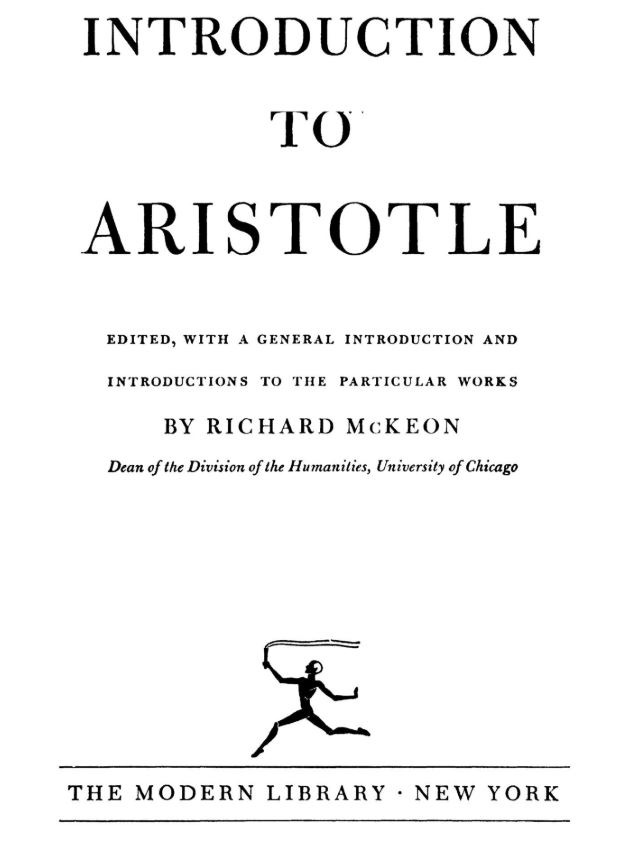
Until the late 1940s McLuhan’s knowledge of Aristotle, aside from the Poetics that he had studied in some detail at Cambridge in the mid 1930s, was mostly secondhand and superficial (when not simply wrongheaded). Then in 1947 he began to engage with McKeon’s anthology, Introduction to Aristotle, which was published that year.
.
This, together with work he was doing then on Eisenstein, Pound and Mallarmé, along with his perennial consideration of Eliot and Joyce, effected such a revolution in his thought that he was able to write in a 1950 review that investigation of “the creative process” (including first of all his own creative process) “must begin (…) in the epistemology and psychology of Aristotle”!3
This was central to his transformation from ‘moralist’ to ‘student’! Since he had been completely wrong about a giant like Aristotle, and had even deemed his ignorance as fitted to morality, what might he not also be utterly wrong about? For McLuhan, such ἁμαρτία necessitated “a totally different approach” and this not as a one-time event, but as a continuing foundational questionability, first of all of his own perceptions, and then of perception in general.4 And while such universal questionability might seem to undermine the very possibility of science, McLuhan agreed with Thomas Kuhn that science and revolution enable each other and do not all contradict.5 Hence McLuhan’s later ever-repeated maxim of the necessity of “making, not matching”: ‘making’ in the sense of the “creative process”. Hence his “new science of media” grounded in, and pursued on the basis of, that process — a process fundamental first of all to “ordinary experience”, but unknown there and, of course, uninvestigated.
In a Commonweal article in 1954 he reflected on this then quite recent fundamental change of orientation as follows:
When I wrote The Mechanical Bride some years ago [1946-1950] I did not realize that I was attempting a defense of book-culture against the new media. I can now see that I was trying to bring some of the critical awareness fostered by literary training to bear on the new media of sight and sound. My strategy was wrong, because my obsession with literary values blinded me to much that was actually happening for good and ill. What we have to defend today (…) must be (…) analytical awareness of the nature of the creative process involved in human cognition. For it is in this citadel that science and technology have already established themselves…6
This “citadel” of “the creative process involved in human cognition” was none other, he came to understand, than the object of investigation in “the epistemology and psychology of Aristotle”. In this way, McLuhan’s originally only critical engagement with the University of Chicago and with Aristotle led him to recognize his own blindness (Aristotle’s ἁμαρτία) and the need to focus on the “creative process” of media (Aristotle’s μεταφορά, μεταβολή and μίμησις).7
The following are posts describing McLuhan’s engagement in the 1940s with the University of Chicago in its rough chronological order:8
McLuhan’s 1940 review of Adler
Giedion to Nef: “a young scholar of English literature”
McKeon, Gilson and Rorty
McLuhan and Aristotle 4 (Synthesis between Plato and Aristotle)
McLuhan and Aristotle 5 (dualisms in 1944)
McLuhan’s realism 6: dialectics and erudition not enough
The Failure at Chicago
Proposal to Robert Hutchins 1947
Nef on McLuhan’s proposal
- For “the identity of the processes of cognition and creation”, see Ordinary apprehension is poetic, where the 1951 dating of the earliest citations is noteworthy. Also: Moment to moment of experience. ↩
- Playboy Magazine, March 1969. ↩
- ‘Book Reviews‘, Renascence 3:1, 1950, 47-48: “Elizabeth Drew’s book (T. S. Eliot: The Design of his Poetry), (…) is labelled ‘a voyage of discovery into the creative process’. Such an undertaking with reference to Eliot’s poetry must begin where Elizabeth Drew has never been — namely in the epistemology and psychology of Aristotle. Joyce saw from the first that the creative process is an analogy of the cognitive process. And Eliot has followed him.” McLuhan might have been speaking of himself here: “where Elizabeth Drew has never been” — like me. ↩
- See ‘Limitation’ in Take Today, Reborn from ruin, Solution lies in the problem. ↩
- It can be argued that the inflection of revolution and science goes the the heart of Plato’s project. Revolution to demonstrable understanding is what the escaped prisoner from Plato’s cave undergoes. ↩
- ‘Sight, Sound, and the Fury’, Commonweal, 60:1, April 9, 1954. McLuhan’s confession here is that his “obsession with literary values” amounted to an unconsidered reduction of the plurality of media to the single medium of literacy. It was somehow entitled to judge them. This “blinded (him) to much that was actually happening for good (even in the new media) and ill (even with literacy)”. “The creative process involved in human cognition” followed immediately since cognition could not take place without deciding among the plural possibilities of media, aka, without the exercise of “the creative process”. Importantly, exactly this criticism had been directed by McLuhan’s mentor in Toronto, Harold Innis, against the 1947 committee report chaired by Robert Hutchins, A Free and Responsible Press (University of Chicago Press, 1947) in a 1949 review of it: “We might ask for separate consideration of the radio, newspapers, motion pictures, magazines, and books rather than a general blur to the effect that whereas the word ‘press’ is used in the publications of the Commission, it refers to all these media (citation from page 2 of the report), since each medium has its peculiarities and an appreciation of this fact is the beginning of a study of the press.” (Canadian Journal of Economics and Political Science, 15:2, 1949, 265-266) As McLuhan was only now beginning to see, above all thanks to Innis, this was true of any study whatsoever. A beginning had to be made with the identification of the particular medium at stake and especially with the peculiarities of that medium: the medium is the message. McLuhan would continue to recall this paradigm shift in his thinking around 1950 for the rest of his life: “we have confused reason with literacy, and rationalism with a single technology” (Understanding Media, 1964, 15). ↩
- McLuhan made frequent recourse to mimesis throughout his career, again beginning in 1951. See Mimesis and Mimesis in Laws of Media. Considerations in his work of ‘metaphor’ and ‘transformation’, along with other translations of μεταφορά and μεταβολή, were more extensive yet: “All words in every language are metaphors” (Laws of Media, 120). “The medium is the message” is a general restatement of these dynamic processes. ↩
- These posts are far from telling the full story. Further posts will enlarge on such topics as McLuhan’s 25 year relation with Sigfried Giedion and his various attempts to instigate Giedion’s ‘faculty of interrelations’; what happened with Giedion’s recommendation of McLuhan to Nef; McLuhan’s friendship with Wyndham Lewis and his attempt to interest Hutchins in bringing Lewis to Chicago; McLuhan’s intimate relation with Bernard Muller-Thym as a bridge to Gilson, McKeon and Aristotle; McLuhan’s long battle with the Great Books program; Hutchins’ investigation into media (A Free and Responsible Press: A General Report on Mass Communications, University of Chicago Press, 1947) as seen by McLuhan and as reviewed by McLuhan’s mentor in Toronto, Harold Innis; McLuhan’s close friendship with Cleanth Brooks, who was a visiting professor at Chicago in 1945, and the battle that ensued between Brooks and Ronald Crane as reflected in Crane’s 1948 ‘Cleanth Brooks; Or, the Bankruptcy of Critical Monism‘; and so on. ↩