In 1928 Rupert Lodge published Plato’s Theory of Ethics in the International Library of Psychology, Philosophy, and Scientific Method, edited by C.K. Ogden. Included with Lodge in the Library were such leading edge figures at the time as G.E. Moore, Ludwig Wittgenstein, C.G. Jung, I.A. Richards, Alfred Adler, C.S. Peirce, T.E. Hulme, E.A. Burtt, Bruno Malinowski, Bertrand Russell. and Jean Piaget. Rich company!1
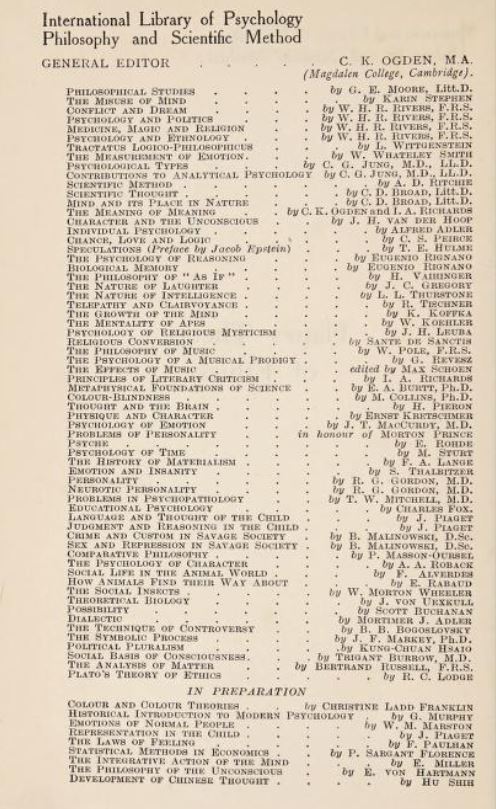
The title page of Plato’s Theory of Ethics introduces him as ‘Professor of Logic and History of Philosophy in the University of Manitoba, and Visiting Lecturer in Philosophy at Harvard University’. Lodge held his visiting lectureship at Harvard in that same year of 1928 in which Plato’s Theory of Ethics was published. He had been at Harvard in 1926 at the sixth international congress of philosophy in his capacity as the president that year of the western division of the APA. He presented a paper at the congress, ‘On a recent hypothesis concerning the Platonic Socrates‘, on am all-star panel with W.D. Ross (representing John Burnet, who was ill), Léon Robin, and Paul Shorey. Presumably Lodge’s invitation to Harvard in 1928 resulted from a good impression made by him there in 1926.
Two years years after the publication of Lodge’s book in Ogden’s ‘International Library’, McLuhan would take the year-long Introduction to Philosophy course at the University of Manitoba which was taught by Lodge in the first semester (classical philosophy, concentrating on Plato) and Henry Wright in the second (modern philosophy and psychology).2
Wright’s course included his latest book, The Moral Standards of Democracy from 1925, perhaps as a set text, perhaps as a background reference. In any case, McLuhan owned the book and studied it carefully. It is preserved, ‘heavily annotated’, in his working library at the University of Toronto.3
Lodge’s course must have included his latest book in some way as well, although Plato’s Theory of Ethics is not found in McLuhan’s library at UT. Perhaps he never found an inexpensive used copy, as he did with Wright’s Moral Standards.4 But because McLuhan’s relation with Lodge was much closer than with Wright, there can be little doubt that he read, and presumably repeatedly read, Lodge’s book. For McLuhan must have quickly realized how exceptional it was, and how potentially important to him personally it was, that a scholar of Lodge’s caliber and international reputation was teaching in Winnipeg.5
For further on Plato’s Theory of Ethics, see Lodge on Plato’s ‘mean’. It seems plain that Plato’s ‘mean’, as articulated by Lodge, is what was to become McLuhan’s ‘medium’ in its important, but little referenced, senses of ‘mediating middle’ and ‘due proportion’.
- Three more books on Plato by Lodge appeared in the same famous series: Plato’s Theory of Education (1947), Plato’s Theory of Art (1953) and The Philosophy of Plato (1956). ↩
- See Lodge and Wright and Henry Wright on Winnipeg in 1920. ↩
- See Henry Wilkes Wright and Henry Wilkes Wright 2. ↩
- Wright’s title, The Moral Standards of Democracy, should be compared to the title and subtitle of Lodge’s book: Plato’s Theory of Ethics — The Moral Criterion and the Highest Good. The compatibility of Lodge and Wright in co-teaching the entrance course to all subsequent philosophy and psychology courses at UM may be seen in the duplication of ‘moral’ in the titles of their books. ↩
- See W.O. Mitchell on Rupert Lodge for Mitchell’s assessment of Lodge and for the life-changing influence of Lodge on him. ↩