Monthly Archives: June 2026

University of Chicago

Marshall McLuhan was engaged with the University of Chicago for the entire decade of the 1940s (his age 29 to 39). Notably, this engagement, which began when McLuhan was a low level lecturer at St Louis University just starting his academic career, came to involve him with the top leadership at UC: Robert Hutchins, John Nef, Richard McKeon, Ronald Crane and Mortimer Adler.

Until late in the decade McLuhan remained a fierce critic of what he took to be the dialectical Aristotelianism there, especially in the work of McKeon, Crane and Adler. This led to an associated criticism of the university’s support, enabled by Hutchins and Nef, of the teaching and research of the three. But his engagement with Chicago and, through it, with Aristotle, brought him by the end of the decade to a life-changing and life-defining change of mind. As he described in his Playboy interview 20 years later, he “ceased being a moralist and became a student”:

For many years, until I wrote my first book, The Mechanical Bride [published in 1951, written in the late 1940s], I adopted an extremely moralistic approach to all environmental technology. I loathed machinery, I abominated cities, I equated the Industrial Revolution with original sin and mass media with the Fall. In short, I rejected almost every element of modern life in favor of a Rousseauvian utopianism. But gradually I perceived how sterile and useless this attitude was, and I began to realize that the greatest artists of the 20th Century — Yeats, Pound. Joyce, Eliot — had discovered a totally different approach, based on the identity of the processes of cognition and creation.1 I realized that artistic creation is the playback of ordinary experience — from trash to treasures. I ceased being a moralist and became a student.2

Until the late 1940s McLuhan’s knowledge of Aristotle, aside from the Poetics that he had studied in some detail at Cambridge in the mid 1930s, was mostly secondhand and superficial (when not simply wrongheaded). Then in 1947 he began to engage with McKeon’s anthology, Introduction to Aristotle, which was published that year.

.
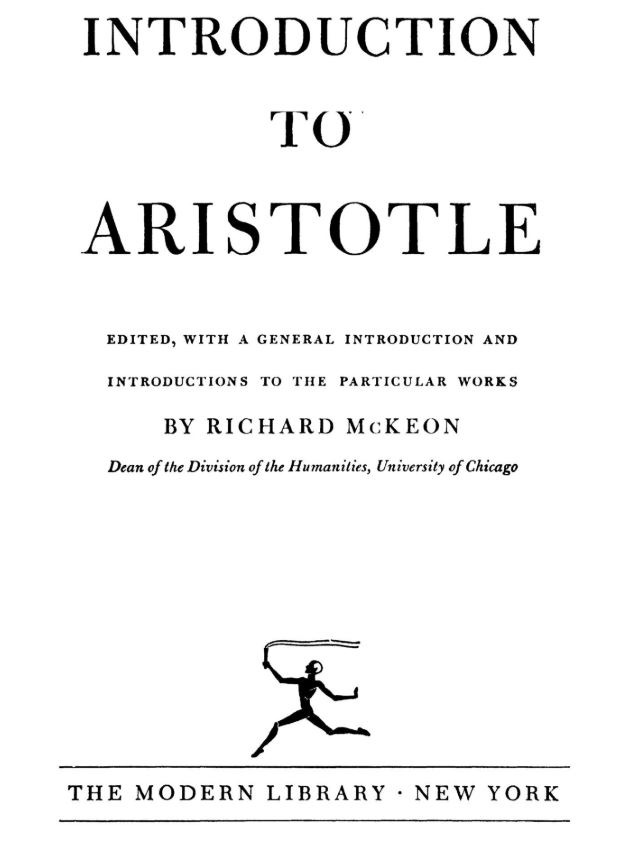
This, together with work he was doing then on Eisenstein, Pound and Mallarmé, along with his perennial consideration of Eliot and Joyce, effected such a revolution in his thought that he was able to write in a 1950 review that investigation of “the creative process” (including first of all his own creative process) “must begin (…) in the epistemology and psychology of Aristotle”!3

This was central to his transformation from ‘moralist’ to ‘student’! Since he had been completely wrong about a giant like Aristotle, and had even deemed his ignorance as fitted to morality, what might he not also be utterly wrong about? For McLuhan, such ἁμαρτία necessitated “a totally different approach” and this not as a one-time event, but as a continuing foundational questionability, first of all of his own perceptions, and then of perception in general.4 And while such universal questionability might seem to undermine the very possibility of science, McLuhan agreed with Thomas Kuhn that science and revolution enable each other and do not all contradict.5 Hence McLuhan’s later ever-repeated maxim of the necessity of “making, not matching”:  ‘making’ in the sense of the “creative process”. Hence his “new science of media” grounded in, and pursued on the basis of, that process — a process fundamental first of all to “ordinary experience”, but unknown there and, of course, uninvestigated.

In a Commonweal article in 1954 he reflected on this then quite recent fundamental change of orientation as follows:

When I wrote The Mechanical Bride some years ago [1946-1950] I did not realize that I was attempting a defense of book-culture against the new media. I can now see that I was trying to bring some of the critical awareness fostered by literary training to bear on the new media of sight and sound. My strategy was wrong, because my obsession with literary values blinded me to much that was actually happening for good and ill. What we have to defend today (…) must be (…) analytical awareness of the nature of the creative process involved in human cognition. For it is in this citadel that science and technology have already established themselves…6

This “citadel” of “the creative process involved in human cognition” was none other, he came to understand, than the object of investigation in the epistemology and psychology of Aristotle”. In this way, McLuhan’s originally only critical engagement with the University of Chicago and with Aristotle led him to recognize his own blindness (Aristotle’s ἁμαρτία) and the need to focus on the “creative process” of media (Aristotle’s μεταφορά, μεταβολή and μίμησις).7

The following are posts describing McLuhan’s engagement in the 1940s with the University of Chicago in its rough chronological order:8

McLuhan’s 1940 review of Adler
Giedion to Nef: “a young scholar of English literature”
McKeon, Gilson and Rorty
McLuhan and Aristotle 4 (Synthesis between Plato and Aristotle)
McLuhan and Aristotle 5 (dualisms in 1944)
McLuhan’s realism 6: dialectics and erudition not enough
The Failure at Chicago
Proposal to Robert Hutchins 1947
Nef on McLuhan’s proposal


  1. For “the identity of the processes of cognition and creation”, see Ordinary apprehension is poeticwhere the 1951 dating of the earliest citations is noteworthy. Also: Moment to moment of experience.
  2. Playboy Magazine, March 1969.
  3. Book Reviews‘, Renascence 3:1, 1950, 47-48: “Elizabeth Drew’s book (T. S. Eliot: The Design of his Poetry), (…) is labelled ‘a voyage of discovery into the creative process’. Such an undertaking with reference to Eliot’s poetry must begin where Elizabeth Drew has never been — namely in the epistemology and psychology of Aristotle. Joyce saw from the first that the creative process is an analogy of the cognitive process. And Eliot has followed him.” McLuhan might have been speaking of himself here: “where  Elizabeth Drew has never been” — like me.
  4. See ‘Limitation’ in Take TodayReborn from ruinSolution lies in the problem.
  5. It can be argued that the inflection of revolution and science goes the the heart of Plato’s project. Revolution to demonstrable understanding is what the escaped prisoner from Plato’s cave undergoes.
  6. ‘Sight, Sound, and the Fury’, Commonweal, 60:1, April 9, 1954. McLuhan’s confession here is that his “obsession with literary values” amounted to an unconsidered reduction of the plurality of media to the single medium of literacy. It was somehow entitled to judge them. This “blinded (him) to much that was actually happening for good (even in the new media) and ill (even with literacy)”. “The creative process involved in human cognition”  followed immediately since cognition could not take place without deciding among the plural possibilities of media, aka, without the exercise of “the creative process”. Importantly, exactly this criticism had been directed by McLuhan’s mentor in Toronto, Harold Innis, against the 1947 committee report chaired by Robert Hutchins, A Free and Responsible Press (University of Chicago Press, 1947) in a 1949 review of it: “We might ask for separate consideration of the radio, newspapers, motion pictures, magazines, and books rather than a general blur to the effect that whereas the word ‘press’ is used in the publications of the Commission, it refers to all these media (citation from page 2 of the report), since each medium has its peculiarities and an appreciation of this fact is the beginning of a study of the press.” (Canadian Journal of Economics and Political Science15:2, 1949, 265-266) As McLuhan was only now beginning to see, above all thanks to Innis, this was true of any study whatsoever. A beginning had to be made with the identification of the particular medium at stake and especially with the peculiarities of that medium: the medium is the message.
  7. McLuhan made frequent recourse to mimesis throughout his career, again beginning in 1951. See Mimesis and Mimesis in Laws of Media. Considerations in his work of ‘metaphor’ and ‘transformation’, along with other translations of μεταφορά and μεταβολή, were more extensive yet: “All words in every language are metaphors” (Laws of Media, 120). “The medium is the message” is a general restatement of these dynamic processes.
  8. These posts are far from telling the full story. Further posts will enlarge on such topics as McLuhan’s 25 year relation with Sigfried Giedion and his various attempts to instigate Giedion’s ‘faculty of interrelations’; what happened with Giedion’s recommendation of McLuhan to Nef; McLuhan’s friendship with Wyndham Lewis and his attempt to interest Hutchins in bringing Lewis to Chicago; McLuhan’s intimate relation with Bernard Muller-Thym as a bridge to Gilson, McKeon and Aristotle; McLuhan’s long battle with the Great Books program; Hutchins’ investigation into media (A Free and Responsible Press: A General Report on Mass CommunicationsUniversity of Chicago Press, 1947) as seen by McLuhan and as reviewed by McLuhan’s mentor in Toronto, Harold Innis;  McLuhan’s close friendship with Cleanth Brooks, who was a visiting professor at Chicago in 1945, and the battle that ensued between Brooks and Ronald Crane as reflected in Crane’s 1948 ‘Cleanth Brooks; Or, the Bankruptcy of Critical Monism‘; and so on.

McLuhan’s 1940 review of Adler

McLuhan led off a decade-long engagement with the University of Chicago1 with a 1940 review in the St Louis University house journal, Fleur de Lis, of Mortimer Adler’s 1937 Art and Prudence.2 It is reproduced here with the permission of the McLuhan estate.

****

[30] This is a big book [686 pages] and a big subject — the movies. In announcing his intention in the work, Mr. Adler says (p. x): “The philosophical task here is the ancient one of clarifying public opinion.” This is a noble task to have undertaken and the reader will be disappointed in proportion to his eagerness at last to read a reasoned discussion of the nature and influence of the great popular art of the movie. Some readers may experience an almost equal dismay at Mr. Adler’s ubiquitous self-assurance and satisfaction in his own performance. Adapting an old figure to our own time we may say, “Turn him to any point of policy, the Gordian knot of it he’ll straight unloose, familiar as his necktie.” Mr. Adler’s glowing sense of accomplishment is similar to the Emperor’s pride in his new clothes.

Mr. Adler explains in the preface (p. xi) how he came to write this book:

As a result of their reading of CRIME, LAW AND SOCIAL SCIENCE,3 representatives of the motion-picture producers asked me to review for them the recent empirical investigations specifically concerned with the influence of motion pictures on human behavior — to make, in short, a similar analysis of the problems, methods and results of research.4

The recent empirical investigations were mainly unfavorable to the movie industry, but its representatives had reason to believe that Mr. Adler would give the industry carte blanche. His report to the producers is incorporated in chapters 10 and 11 of Part III of the present volume. It is a novel situation when big business calls in a philosopher to clarify public opinion. At least such circumstances might very well lead a philosopher to reconsider his position.

The major positions of this book are not hard to state. The current confused attitudes toward the movies are put in a historical perspective because “Much of the prevailing discussion proceeds upon the provincial assumption that the problem being discussed is a new one, peculiar to the locale of Europe and America in the twentieth century.”5 Beginning with Plato and Aristotle, Mr. Adler continues with a discussion of esthetics in Christendom and finally under Democracy. (Democracy is defined, p. 93, in the Dewey manner, not as a kind of government but as that mode of human association inescapable in a highly industrialized and technical society. Thus Mr. Adler is able to state, and Mr. Dewey unable to escape, the conclusion that “Russia, Italy, and Germany today are democratic.”) This is followed by a chapter of “Historical Transformations,” which is concerned with the history and function of censorship. From this point onwards the volume is given over to the contemporary issue of art versus prudence as it arises in daily debates about the movie.

This historical survey is designed to establish first that Plato assumes an absolutist position with regard to the arts. It is not enough that they should give pleasure, but they must, and in fact do, teach. But what they teach is at best inferior to philosophical knowledge. Therefore, they must be rigidly controlled and subordinated to the philosophical disciplines.

The second position is that of Aristotle, who sets the arts in relation to everyday life and makes no special demands of them beyond requiring that they give pleasure at the appropriate levels. The pleasure provided by even the crudest art constitutes a purgation of the correspondent passions which in actual practice sustains men in the pursuit of such virtues as they might otherwise lose the courage to follow. They provide moments of salutary contemplation for which, as Plato truly saw, men [already] leading the good life have no need.

The third position is that of Christianity. It is the Platonic position qualified by the doctrine of original sin. The first function of the arts is to instruct in virtue — the philosopher and [31] the saint have no need of them. They are barely tolerated as a concession to human nature. But “Aquinas provides a Christian answer to Bossuet as Aristotle gave a Greek answer to Plato” (p. 20).

Mr. Adler insists on a fourth position for Democracy, though he describes rather than defines Democracy, and one is left to infer the position. Democracy is for him not an ideal nor clearly conceived form of government. It is the result of the mechanization of society and the obliteration of all save economic distinctions between persons and social classes. Thus “one cannot live in a democracy and despise the popular arts” (p. 114). Art in a democracy is an instrument in an instrumental society. And it is thus peculiarly fitting that the art form of a mechanized sub-human society should be highly mechanized. This is the movie. It alone provides for the masses a sense of mass participation in all the functions of society. At a very low level, it is true, it nevertheless constitutes a mode of communication between all the functional units of society (units which were formerly persons) without which it is scarcely possible to conceive of Democracy.

From this point on Mr. Adler sings a paean of praise to the movies, brushing aside the critics with a priori exuberance. The historical matter which has been indicated is efficiently used as a conjuror’s cloak into which disappear all possible objections. If any kind of art gives pleasure then it necessarily effects a catharsis of the emotions (of whatever kind) which are involved. Thus any kind of art which gives pleasure is innocuous. If the art does not effect some sort of purgation of the emotions relevant to its matter, the consequent pain will effect more than any censorship can do. Thus can and ought prudence to regard the movies.

This view is upheld on the assumption that historically all confusion between the practical intellectual virtues of art and prudence is Platonist, whereas true discernment of their radical difference is Aristotelian. That so flagrant an historicism should be foisted off as plausible is understandable in the light of Mr. Adler’s bold streamlining of history. For the historical portion of the work does real violence to the issues. As an example of special pleading consider this statement (p. 591):

The conflict between poetry and politics is a special case of the antimony of art and prudence. It may be suggested that Plato solves this antimony by his conception in the Laws of a Minister of Education who is at once the curator of public morals and censor of the arts. He must be a prudent man who understands art, and an artist who possesses the special art of prudence in addition to all others. This would be the reconciliation between art and prudence, which as Maritain says, only “wisdom, being endowed with the outlook of God and ranging over Action and Making alike” can achieve.

Since Mr. Adler makes poetry a term to cover all fictions, including the movie, the question immediately arises as to what other cases of conflict between art and prudence could occur outside the range of poetry and politics. And the word “antimony” is unfortunate since used in regard to Mr. Adler’s view of art and prudence it contradicts his own thesis. For his thesis is that there is no antinomy, but merely accidental opposition between art and prudence. In his next two sentences he misrepresents Plato completely. Plato makes it quite clear that the critic cannot be an artist, though he ought to have some knowledge of the technical problems of the arts. And this fact makes the last sentence, with the specially selected missile from Maritain, quite unfair. It is a complete fallacy to conclude that because art and prudence are separate virtues of the practical intellect, both must be present in their perfection before either may be permissibly regulative of the other. This is Mr. Adler’s thesis, and it represents precisely that extravagant intellectualism which he indicates as being the peculiar weakness of Plato and the Platonists.

[32] Mr. Adler commits over and over again the very errors which he claims to be exposing. For example, he says (p. xii):

The moral and political criticism of an art is usually exaggerated and even distorted by a lack of sensitivity to its problems of workmanship and production, its artistic aims and its technical means.

Now this lack of sensitivity and absence of concern for the technical means and artistic aims of the movie is one of the most striking deficiencies of the volume under review. Mr. Adler loses the reader’s respect for his critical capacity in relation to the movies precisely in the degree to which he ventures to make a particular comment about a particular movie. One was not surprised, therefore, to discover (p. 668) that Pudovkin [1893-1953]6 is brushed aside because “he is an artist writing analytically about his art, which is clearly not the art of analysis itself.” The trouble with Pudovkin’s Film Technique [1926; translation 1933] and its followers is, from Mr. Adler’s point of view, that they make a drastic critique of the movie he is defending within the limits of the art itself. Pudovkin and all the critics who speak from a knowledge of the artistic aims and the technical means of the movie are much more devastating and effective in their comment on the old bag of stage tricks which Hollywood serves up as film art than the Hays7 office. The real case against Hollywood is not a moral one, but an artistic one. The average film is not only badly made, but it fails to give pleasure as well. Stunts entirely extraneous to the art itself are constantly introduced to pep up the jaded patrons.

To come directly to grips with Mr. Adler’s thesis, he fails to show that those who attack art on moral grounds possess even the virtue of prudence, let alone a knowledge of art. It would not be hard to make out a stronger case for quite a different thesis, namely, that the artist in his primary concern for the integrity of the thing to be made can never violate good morals. Because, any conscious violation of morals introduces an inartistic element into the work of art.

To make an end rather than to conclude, Mr. Adler might have written a better book had he written from a less controversial motive. It may be stated as a general principle underlying the relation of art and prudence, of poetry and politics, that the artist receives the matter of his art from the community of experience at a particular time and place. This experience in the case of drama, poetry, novel, movie, is essentially ethical in character (music escapes from this category). While the ethical matter of these arts is accidental to the arts themselves, it ought to be subject to the same prudential considerations as the same matter in non-artistic contexts. Thus the prudential aspect of the artist’s matter or vehicle becomes for the artist a further technical problem. As such it in no way frustrates the artist. On the contrary, the worst problem for the artist is to be confronted with an immoral society — when the matter and vehicle of the arts become increasingly non-ethical and confused, the artist has to make bricks without straw, he has to make matter and form vehicle as well as content.8

  1. For posts detailing this engagement, see University of Chicago.
  2. ‘Review of Art and Prudence by Mortimer J. Adler’, Fleur de Lis, 40:1 (October 1940), 30-32.
  3. Crime, Law and Social Science by Jerome Michael and Mortimer Adler, 1933.
  4. It may be that motion-picture producers were attracted by the critique Michael and Adler make in Crime, Law and Social Science of “salvational schemes” (238): “The motion picture, the press, the novel, are supposed to be causes of crime, and it has therefore been suggested that censorship would be a preventive of crime.” (238-239) However, as Michael and Adler repeatedly note: “There are no quantitative studies” (238 n18 — identical with 238 n17 and 239 n20). Michael and Adler continue: “All of the foregoing programs (…) are advanced by their sponsors as if they were clearly based upon knowledge. They have, of course, no such foundation. They are rather based upon opinions which are hazarded in the absence of knowledge (…) Furthermore, these programs are for the most part extremely simple-minded. They completely ignore the complexity of the etiology of human behavior. (…)  At any rate, it is important to recognize that if the opinions upon which these plans are based are treated as if they were knowledge, the actual practice of (crime and other social ill) prevention becomes unenlightened and uncritical” (240).
  5. In regard to “provincial assumption”, see McLuhan’s review of American Renaissance by E O. Matthiessen, Fleur de Lis, 41:1, October 1941: “he fails to evaluate his writers critically because he understands no tradition of literary achievement except the priggishly provincial one represented by Emerson and the rest.”
  6. The film theory of Vsevolod Pudovkin and of his friend Sergei Eisenstein was critical to McLuhan’s understanding of technology and communication. He began reading what was available of them in translation already in the 1930s.
  7. For the Hays Code, see
    https://en.wikipedia.org/wiki/Motion_Picture_Production_Code
    https://en.wikipedia.org/wiki/Will_H._Hays
    https://tvtropes.org/pmwiki/pmwiki.php/UsefulNotes/TheHaysCode
  8. Almost two decades later, in 1958, this will become “the medium is the message”. See The medium is the message in 1958.